Attensity was an American company that provided social analytics and engagement applications for social customer relationship management (social CRM). Attensity's text analytics software applications extracted facts, relationships and sentiment from unstructured data. == History == Attensity was founded in 2000. An early investor in Attensity was In-Q-Tel, which funds technology to support the missions of the US Government and the broader DOD. InTTENSITY, an independent company that has combined Inxight with Attensity Software (the only joint development project that combines two InQTel funded software packages), was the exclusive distributor and outlet for Attensity in the Federal Market. In 2009, Attensity Corp., then based in Palo Alto, merged with Germany's Empolis and Living-e AG to form Attensity Group. In 2010, Attensity Group acquired Biz360, a provider of social media monitoring and market intelligence solutions. In early 2012, Attensity Group divested itself of the Empolis business unit via a management buyout; that unit currently conducts business under its pre-merger name. Attensity Group was a closely held private company. Its majority shareholder was Aeris Capital, a private Swiss investment office advising a high-net-worth individual and his charitable foundation. Foundation Capital, Granite Ventures, and Scale Venture Partners were among Biz360's investors and thus became shareholders in Attensity Group. In February 2016, Attensity's IP assets were acquired by InContact, and Attensity closed.
Twproject
Twproject (say: T W Project) is a web-based project and groupware management tool created by Open Lab, an Italian software house founded in 2001. It won the 17th Jolt Productivity Award in 2007 in the project management category. In March 2019 it becomes property of Twproject company. It has widespread use in universities as a teaching tool in project management courses. It is used by Oracle Corporation, Prada, Calzedonia, General Electric and many other companies from corporations to small start-ups. == History == April 2001 - The idea of Teamwork came to Open-Lab founders from a need to overcome the PM tools used at that time. It was built in Microsoft ASP and Adobe Flash November 2002 - Open-Lab decide to move from Flash to HTML and from ASP to Java-JSP. Teamwork 2 development is started. June 2004 - Teamwork 2 released, using top open-source technologies like Hibernate, jBlooming, dynamic CSS, Ajax 7 January 2005 - Teamwork goes open source, under LGPL license; remains such until June 2006 (18 months): it is a hit application on SourceForge, with 38.000 downloads, covered by greeting but starving April 2005 - Open-Lab takes the decision to change commercial strategy to finance development of Teamwork version 3 6 June 2006 - Teamwork 3 is finally out (15 months development). New interface, many new features, agile support and much more 27 March 2007 - Teamwork wins the 2007 JOLT Productivity Awards for project management category July 2007 - Teamwork 4 development started: new interface, extended use of new HTML capabilities, JS-oriented interface, start using jQuery February 2009 - Teamwork 4.0 is out February 2010 - Teamwork 4.4: public project pages, Chinese interface. jQuery is getting more space in Teamwork December 2010 - Teamwork 4.6: released Mobile module available for iPhone, Android, BlackBerry. Intensive usage of jQuery June 2011 - Teamwork 4.7: released Issue Kanban / Organizer January 2012 - Teamwork 5.0 development started. Lighter interface, extensive usage of dynamic pages, easier installer and first time approach. Learning curve highly reduced. A jQuery Gantt editor included and released free for the community July 2012 - Teamwork 5 released and also the free online Gantt editor November 2012 - Teamwork 5.1 with new trees and improved model for staffing March 2013 - Teamwork 5.2 with stronger support for customizations and Japanese interface. April 2014 - Teamwork has changed its name in Twproject because the domain teamwork.com has been purchased by Teamwork. April 2013 - Twproject 5.4 with a redesigned more powerful Gantt chart. August 2015 - Twproject 5 finale release. September 2015 - Twproject 6 with a completely redesigned user interface. March 2019 - A new company Twproject srl has been spun off. September 2021 - Twproject 7 has been released introducing WBS based management and workload management. == Features == Project & task management (with Microsoft Project import/export), and JSON format Gantt editor. Uses jQuery Gantt components Time tracking. Several entry points: dashboard, weekly view, issues, start/stop buttons Resource planning with weekly/monthly view, work load overview, unavailability from agenda Issue tracking & planning(with Kanban), e-mail integration, task dedicated inboxes Dashboard configuration, with customizable portlets and layout Message boards Scrum module Meeting and minute management, attached documents Agenda (Integrates with iCal, Microsoft Outlook, Microsoft Entourage, and Google Calendar) Document management, remote file systems link with NTFS, FTP, SVN, S3 (Dropbox, Google drive) Mobile application for iPhone, iPad, Android, Blackberry, Windows phone == Integration == A complete JSON API is available for integrations. The applications runs in Java JDK 8+ on the Hibernate object/relational mapping. The standard distribution uses Apache Tomcat 9, but can run on any J2EE application server. Twproject is tested on these DB servers: MySQL, Oracle, SQL Server, PostgreSql, HSQLDB, but as uses Hibernate can run on many others. There is simple graphical step-by-step installer for Windows, Mac, Linux, .zip/.tar.gz/.rpm packages.
International Conference on Autonomous Agents and Multiagent Systems
The International Conference on Autonomous Agents and Multiagent Systems or AAMAS is the leading scientific conference for research in the areas of artificial intelligence, autonomous agents, and multiagent systems. It is annually organized by a non-profit organization called the International Foundation for Autonomous Agents and Multiagent Systems (IFAAMAS). == History == The International Conference on Autonomous Agents and Multiagent Systems (AAMAS) is a highly respected joint conference that provides a quality forum for discussing research in intelligent computational agents and their interactions. It is a merger of three major international conferences/workshops, namely the International Conference on Autonomous Agents (AGENTS), International Conference on Multi-Agent Systems (ICMAS), and International Workshop on Agent Theories, Architectures, and Languages (ATAL). ICMAS is itself a merger of three formative workshops, each with an attendance of fewer than 50 researchers. At a meeting during IJCAI-93 held in Chambery, France in August 1993, the leaders of the European Workshops on Modelling Autonomous Agents in a Multi-Agent World, the Asian MAAC Workshops, and the North American Distributed Artificial Intelligence Workshops (Victor Lesser, Michael N. Huhns, Les Gasser, Barbara Grosz, Nicholas Jennings, Michael Wooldridge, Gerhard Weiss, Mario Tokoro, and Toru Ishida) began the planning for a combined conference, which resulted in the first ICMAS in San Francisco, CA, USA in 1995, attended by more than 500 researchers. The AAMAS Conference is under the guidance and management of the International Foundation for Autonomous Agents and Multiagent Systems, which is incorporated as a 501(c)(3) non-profit organization in South Carolina, USA. == Current and previous conferences == 2024: Auckland, New Zealand (May 6-10) 2023: London, United Kingdom (May 29-June 1) 2022: Auckland, New Zealand (May 9–13) 2021: London, United Kingdom (May 3-May 7) 2020: Auckland, New Zealand (May 9–13) 2019: Montreal, Canada (May 13–17) 2018: Stockholm, Sweden (July 10–15) 2017: São Paulo, Brazil 2016: Singapore City, Singapore 2015: Istanbul, Turkey 2014: Paris, France 2013: Saint Paul, USA 2012: Valencia, Spain 2011: Taipei, Taiwan 2010: Toronto, Canada 2009: Budapest, Hungary 2008: Estoril, Portugal 2007: Honolulu, USA 2006: Hakodate, Japan 2005: Utrecht, The Netherlands 2004: New York, USA 2003: Melbourne, Australia 2002: Bologna, Italy == Activities == Besides the main program that consists of a main track, an industry and applications track, and a couple of special area tracks, AAMAS also hosts over 20 workshops (e.g., AOSE, COIN, DALT, ProMAS, to mention a few) and many tutorials. There is also a demonstration session and a doctoral symposium. Finally, each year AAMAS features a bunch of awards, most notably the IFAAMAS Influential Paper Award. It publishes proceedings which are available online.
Feeding the Machine (book)
Feeding the Machine: The Hidden Human Labour Powering AI is a 2024 book by James Muldoon, Mark Graham and Callum Cant. == Writing == The authors developed the concept for the book while doing fieldwork studying data annotation in developing countries in East Africa. == Synopsis == The book examines the human input needed to develop and sustain AI ecosystems. == Reception == The book received positive reviews. Rosalie Waelen of Capital & Class gave it a mostly positive review. Tim Hornyak of Literary Review praised it. Kirkus Reviews called it "A sobering and timely—if sometimes distracted—study of AI.". Publishers Weekly gave the book a starred review, writing that "The grim real-life stories read like dystopian parables, such as the account of a European voice actor whose recordings were legally used without her consent to create an inexpensive synthetic clone whom she now competes with for business. Driven by striking reporting and finely observed profiles, this unsettles."
SpreeAI
SpreeAI (stylized as SPREEAI) is an American fashion technology company headquartered in Incline Village, Nevada that develops artificial intelligence software for the apparel and retail industries, including photorealistic virtual try-on, AI-powered sizing recommendations, and digital model generation. Founded in 2022 by John Imah and Bob Davidson, the company achieved unicorn status in 2025 following a Series B round led by Davidson Group that valued the company at approximately US$1.5 billion. TechCrunch identified SpreeAI as one of the more than 100 new tech unicorns minted in 2025. Its board of directors includes supermodel Naomi Campbell and hospitality executive Larry Ruvo. == History == SpreeAI was founded in 2022 by John Imah and Bob Davidson with a focus on artificial intelligence applications in fashion retail. By 2024, the company had raised approximately US$60 million in venture funding. In May 2025, SpreeAI announced a Series B round led by Davidson Group; reporting at the time placed the company's valuation at approximately US$1.5 billion, making it one of a small number of fashion-technology companies to reach unicorn status. In January 2026, TechCrunch listed SpreeAI among the more than 100 new tech unicorns minted in 2025. == Technology == SpreeAI develops a suite of artificial intelligence tools for the apparel industry. Its consumer-facing platform allows shoppers to upload a single photograph or select a digital model and then visualize clothing items on that figure with photorealistic rendering, while a complementary sizing engine generates fit recommendations intended to reduce returns. The platform is designed for integration with online retailers so that shoppers can preview garments before purchase. The company has stated that its models were developed in part through research collaborations with the Massachusetts Institute of Technology and Carnegie Mellon University. == Leadership and board == John Imah, a Nigerian-American technology executive who previously held roles at Samsung, Twitch, Meta Platforms, and Snap Inc., is co-founder and chief executive officer. Co-founder Bob Davidson, through Davidson Group, led the company's Series B financing. The company's board of directors includes supermodel Naomi Campbell, who joined in 2024, and Las Vegas hospitality executive Larry Ruvo. == Partnerships == SpreeAI has formed partnerships across both academia and the fashion industry. Council of Fashion Designers of America (CFDA). In 2025, SpreeAI entered a partnership with the CFDA to support American designers and brands with AI-driven tools; the CFDA described SpreeAI as "a fashion technology leader delivering innovative solutions to help designers and brands thrive." Massachusetts Institute of Technology and Carnegie Mellon University. The company has cited ongoing research and talent collaborations with both institutions. Sergio Hudson and Kai Collective. In 2025, SpreeAI made what WWD described as its Met Gala debut through a custom collaboration with designer Sergio Hudson and Nigerian-British label Kai Collective; the collaboration paired Hudson's couture with SpreeAI's virtual try-on platform. == Recognition == In 2025, TechCrunch named SpreeAI among the new tech unicorns of the year. In 2025, SpreeAI was named an honoree in Inc.'s Best in Business awards, and CEO John Imah was included on Inc.'s list of 40 business leaders who "propelled their organizations to success." In 2025, Imah was named to the Observer's AI Power Index, a list of 100 leaders shaping the future of artificial intelligence. In 2025, Imah was included in AfroTech's Future 50, recognizing Black innovators in technology. SpreeAI and Imah have been the subject of profile coverage in The Washington Post, Rolling Stone UK, WWD, Vogue UA, L'Officiel Arabia, GQ South Africa, and Inc..
KeyBase
KeyBase is a database and web application for managing and deploying interactive taxonomic keys for plants and animals developed by the Royal Botanic Gardens Victoria. KeyBase provides a medium where pathway keys which were traditionally developed for print and other classical types of media, can be used more effectively in the internet environment. The platform uses a concept called "keys" which can be easily linked together, joined with other keys, or merged into larger other seamless keys groups, with each still available to be browsed independently. Keys in the KeyBase database can be filtered and displayed in a variety of ways, filters, and formats.
R.U.R.
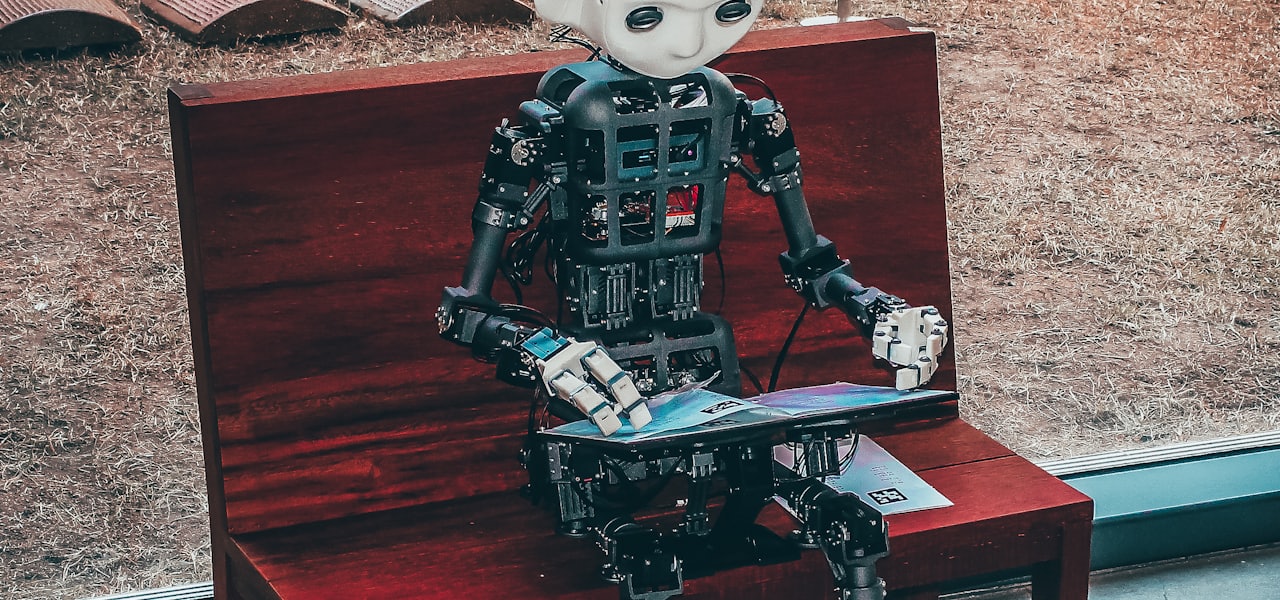
R.U.R. is a 1920 science fiction play by the Czech writer Karel Čapek. "R.U.R." stands for Rossumovi Univerzální Roboti (Rossum's Universal Robots, a phrase that has been used as a subtitle in English versions). The play had its world premiere on 2 January 1921 in Hradec Králové. It introduced the word "robot" to the English language and to science fiction as a whole. R.U.R. became influential soon after its publication. By 1923, it had been translated into thirty languages. R.U.R. was successful in its time in Europe and North America. Čapek later took a different approach to the same theme in his 1936 novel War with the Newts, in which non-humans become a servant-class in human society. == Characters == Parentheses indicate names which vary according to translation. On the meaning of the names, see Ivan Klíma: Karel Čapek: Life and Work (2002). == Plot == === Synopsis === The play begins in a factory that makes artificial workers from synthetic organic matter. (As living creatures of artificial flesh and blood, that later terminology would call androids, the playwright's 'roboti' differ from later fictional and scientific concepts of inorganic constructs.) Robots may be mistaken for humans but have no original thoughts. Though most are content to work for humans, eventually a rebellion causes the extinction of the human race. === Prologue (Act I in the Selver translation) === Helena, the daughter of the president of a major industrial power, arrives at the island factory of Rossum's Universal Robots. Here, she meets Domin, the General Manager of R.U.R., who relates to her the history of the company. Rossum had come to the island in 1920 to study marine biology. In 1932, Rossum had invented a substance like organic matter, though with a different chemical composition. He argued with his nephew about their motivations for creating artificial life. While the elder wanted to create animals to prove or disprove the existence of God, his nephew only wanted to become rich. Young Rossum finally locked away his uncle in a lab to play with the monstrosities he had created and created thousands of robots. By the time the play takes place (circa the year 2000), robots are cheap and available all over the world. They have become essential for industry. After meeting the heads of R.U.R., Helena reveals that she is a representative of the League of Humanity, an organization that wishes to liberate the robots. The managers of the factory find this absurd. They see robots as appliances. Helena asks that the robots be paid, but according to R.U.R. management, the robots do not "like" anything. Eventually Helena is convinced that the League of Humanity is a waste of money, but still argues robots have a "soul". Later, Domin confesses that he loves Helena and forces her into an engagement. === Act I (Act II in Selver) === Ten years have passed. Helena and her nurse Nana discuss current events, the decline in human births in particular. Helena and Domin reminisce about the day they met and summarize the last ten years of world history, which has been shaped by the new worldwide robot-based economy. Helena meets Dr. Gall's new experiment, Radius. Dr. Gall describes his experimental robotess, also named Helena. Both are more advanced, fully-featured robots. In secret, Helena burns the formula required to create robots. The revolt of the robots reaches Rossum's island as the act ends. === Act II (Act III in Selver) === The characters sense that the very universality of the robots presents a danger. Echoing the story of the Tower of Babel, the characters discuss whether creating national robots who were unable to communicate beyond their languages would have been a good idea. As robot forces lay siege to the factory, Helena reveals she has burned the formula necessary to make new robots. The characters lament the end of humanity and defend their actions, despite the fact that their imminent deaths are a direct result of their choices. Busman is killed while attempting to negotiate a peace with the robots. The robots storm the factory and kill all the humans except for Alquist, the company's Clerk of the Works (Head of Construction). The robots spare him because they recognize that "He works with his hands like a robot. He builds houses. He can work." === Act III (Epilogue in Selver) === Years have passed. Alquist, who still lives, attempts to recreate the formula that Helena destroyed. He is a mechanical engineer, though, with insufficient knowledge of biochemistry, so he has made little progress. The robot government has searched for surviving humans to help Alquist and found none alive. Officials from the robot government beg him to complete the formula, even if it means he will have to kill and dissect other robots for it. Alquist yields. He will kill and dissect robots, thus completing the circle of violence begun in Act Two. Alquist is disgusted. Robot Primus and Helena develop human feelings and fall in love. Playing a hunch, Alquist threatens to dissect Primus and then Helena; each begs him to take him- or herself and spare the other. Alquist now realizes that Primus and Helena are the new Adam and Eve, and gives the charge of the world to them. == Čapek's conception of robots == The robots described in Čapek's play are not robots in the popularly understood sense of an automaton. They are not mechanical devices, but rather artificial biological organisms that may be mistaken for humans. A comic scene at the beginning of the play shows Helena arguing with her future husband, Harry Domin, because she cannot believe his secretary is a robotess: His robots resemble more modern conceptions of man-made life forms, such as the Replicants in Blade Runner, the "hosts" in the Westworld TV series and the humanoid Cylons in the re-imagined Battlestar Galactica, but in Čapek's time there was no conception of modern genetic engineering (DNA's role in heredity was not confirmed until 1952). There are descriptions of kneading-troughs for robot skin, great vats for liver and brains, and a factory for producing bones. Nerve fibers, arteries, and intestines are spun on factory bobbins, while the robots themselves are assembled like automobiles. Čapek's robots are living biological beings, but they are still assembled, as opposed to grown or born. One critic has described Čapek's robots as epitomizing "the traumatic transformation of modern society by the First World War and the Fordist assembly line". === Origin of the word robot === The play introduced the word robot, which displaced older words such as "automaton" or "android" in languages around the world. In an article in Lidové noviny, Karel Čapek named his brother Josef as the true inventor of the word. In Czech, robota means forced labour of the kind that serfs had to perform on their masters' lands and is derived from rab, meaning "slave". The name Rossum is an allusion to the Czech word rozum, meaning "reason", "wisdom", "intellect" or "common sense". It has been suggested that the allusion might be preserved by translating "Rossum" as "Reason" but only the Majer/Porter version translates the word as "Reason". == Production history and translations == The work was published in two differing versions in Prague by Aventinum, first in 1920, followed by a revised version in 1921. After being postponed, it premiered at the city's National Theatre on 25 January 1921, although an amateur group had by then already presented a production. By 1921, Paul Selver translated either the original 1920 edition of R.U.R. or a manuscript copy close to this version into English. He probably translated the play freelance, and sold it to St Martin's Theatre in London. Selver's translation was adapted for the British stage by Nigel Playfair in 1922, but it was not produced straight away. Later that year performance rights for the U.S. and Canada were sold to the New York Theatre Guild, perhaps during Lawrence Langner's visit to Britain. Playfair's version included several changes to Čapek's original play, such as renaming the acts (the prologue became act one, and the heavily abridged final act became the epilogue), omitting around sixty lines (including most of Alquist's final speech), adding several more lines, and removing the robot character Damon (giving his lines to Radius). The omission of some lines may have been censorship from the Lord Chamberlain's Office, or self-censorship in anticipation of this, while some other changes might have been made by Čapek himself if Selver was working from a manuscript copy. An edition of Playfair's adaptation was published by the Oxford University Press in 1923, and Selver went on to write a satiric novel One, Two, Three (1926) based on his experiences getting R.U.R. staged. The American première was produced by the Theatre Guild at the Garrick Theatre in New York City in October 1922, where it ran for 184 performances. In the first performance, Domin was portrayed by Basil Sydney,